31 January, 2009

Irrationality x 2

Peter Berkowitz opines on two sides of the same coin: Bush hatred and Obama idolatry.

HT: Real Clear Politics

I guess they've noticed


Even the Iranians recognize what President Obama and his synophants in and out of the media seem unable to see: that a posture of "reason" toward the homicidal nut-jobs who are running the Islamic Republic is a policy of weakness.

Even the totalitarian fanatics acknowledge the bankruptcy of negotiating with totalitarian fanatics.

HT: Drudge

30 January, 2009

The Washington Post's Robinson is delusional

Utterly delusional.

The deficit-multiplying stimulus package the House just passed at President Obama's behest will be enough to inspire a great deal of saving and debt-paying. It will not do nearly as much to stimulate the economy as the media are so sure it will.

Tax cuts are more stimulating, in any case, than government spending. The liberal Ur-myth to the contrary, it was World War II, and not the spending programs of the New Deal, which brought us out of the Great Depression- as even FDR finally had to admit when he acknowledged the passing of our sick economy from the care of "Dr. New Deal" to that of "Dr. Win-the-War." The bill for any spending we do is going to come due some day. One cannot reconstruct the economy by endlessly spending money we do not have.

Yet even to the extent that government spending will help, the Obama package is inadequate to do more than enable our private financial prudence. It is simply not a solution to the economic crisis, and Robinson and others delude themselves when they insist that it is.

The solution- and I'm confident that we'll find one- will come from a bi-partisan effort calling upon the best minds of both parties, and neither. It will not be found in the fawning adherance to the Cult of the One which seems to have blinded so many Americans to the fact that we're a constitutional democracy in which the cult of personality has less place than the cult of common sense.

Michael Steele new GOP national chair

Good choice, IMHO.


HT: Real Clear Politics, Drudge

"Obama raises his hand, and lifts a nation"

So speaks CNN.

No. No liberal bias. None at all.

Why do I bother?


I said last October that as far as I was concerned, the Cubs season would begin next October. Winning a third consecutive division championship and then losing in the first round of the playoffs doesn't cut it this year. I'd just as soon they not make the post season at all.

Despite my satisfaction with the Trib's apparent decision to sell the team to lifelong Cub fan Tom Ritter, as far as I can see the team has essentially gone backward since they broke our hearts in the playoffs- a rather familiar pattern for Chicago sports franchises at the very moment when they ought to be doing whatever it takes to get to the next level. The Jake Peavy deal is apparently dead once and for all,, and for what can't be all that much of a financial difference they've decided to sign Paul Bako instead of retaining Henry Blanco as their backup catcher.

Mark DeRosa, one of their most dependable players not only during the regular season but during the October meltdown, has already been given away to Cleveland for prospects who will probably be of no help this year.

Not for the first time in the fifty-two seasons I've rooted for the Cubs, I'm beginning to wonder why I bother.

29 January, 2009

Blagojevich out

Illinois Gov. Rod Blagojevich has been unanimously convicted by the state senate on impeachment charges, ousted from office, and banned from ever again seeking elective office in Illinois.

In a trial involving the same charges he's facing in a criminal investigation, he was denied the right to call any witness in his defense who might be called in the criminal trial.

One may well applaud the result, while deploring the manner of its obtaining.

Blago ousted, barred for life from elective office


Denied the opportunity to summon witnesses who might be called in his criminal trial- and therefore who might be able to offer evidence relevant to the case against him- Illinois Gov. Rod Blagojevich has been unanimously convicted by the state senate in his impeachment trial and ousted from office.

In a second, seperate vote, the senators voted to impose the "political death penalty," barring Blagojevich from ever seeking elective office in Illinois again.

Did Blago deserve it? Almost certainly.

Did he get a fair trial? Not a chance.

Too good to be true

Just for a moment, it really looked like this week's TIME wasn't going to have Barack Obama on the cover for a change....

I wonder what the record is for consecutive weeks on the cover of the same news magazine?
HT: Drudge

26 January, 2009

Cubs' new owner seems like a winner


A belated word about my Cubs: the Chicago Tribune has announced that billionare Tom Ricketts- a lifelong Cubs fan who met his wife at Wrigley Field, and once lived across the street from it- has been selected as the team's new owner.
While most of us have been rooting for Mark Cuban, his legal difficulties and the problems he undoubtedly would have had being approved by the other owners made him effectively a non-starter. In Ricketts, we have an owner with both deep pockets and a dedication to seeing the team win.

All things considered, it's hard to see how we could realistically have had a better outcome. So let's go out and get Jake Peavy now, and end this one hundred and one year draught!

Is Blagojevich right about being railroaded?

John Faber raises an interesting point: Illinois Gov. Rod Blagojevich, whose impeachment trial began today, has already had the case for the prosecution made in the media. No particular standard of proof is required for members of the State Senate to remove Blagojevich from office.

That being the case, the rules which prevent either Blagojevich or the managers for the prosecution in the Senate from summoning witnesses who might have to testify later in Blagojevich's criminal trial operate against Blagojevich in a way they simply don't operate against the managers for the prosecution. In fact, they effectively prevent Blagojevich from disproving those charges- from answering a case for his removal from office which to all intents and purposes has already been made in the media.

Maybe Blagojevich- who is boycotting the trial on the ground that it's a sham- has a point. Granted, the Sixth Amendment only applies to criminal charges. But it's hard to see that technicality as a legitimate excuse to deny somebody facing even an impeachment trial the right "to be confronted with the witnesses against him; to have compulsory process for obtaining witnesses in his favor."

Guilty or innocent, Blagojevich's impeachment trial is a sham

Impeached Illinois Gov. Rod Blagojevich, whose trial before the Illinois Senate began a few hours ago, is exactly right. He is being railroaded. The impeachment process, as it's being carried out, is a travesty of due process, and I am shocked that there hasn't been an outcry that obvious fact.

Blagjoevich's guilt or innocence isn't the issue. Guilty or innocent, his trial is a sham, just as he maintains. Quite honestly, he is absolutely right to boycott a trial in which he is being denied the opportunity to confront his accusers or defend himself against their charges.

I have absolutely no brief for Blagojevich. None whatsoever. Such evidence as is accessible to the public portrays him as a grotesquely corrupt politician in a state which (as much as it pains me to say this, since I was born and raised there) has, along with Louisiana, probably the most corrupt history of any in the nation. But the fact remains that the kangaroo court being conducted in the Illinois Senate is proceeding under rules which deny him the opportunity to summon any witness in his defense who might be called upon to testify in his criminal trial.

That the managers for the prosecution in the Illinois Senate are operating under the same restriction is neither here nor there. The standards of evidence required for conviction are not the same as in a criminal proceeding; senators' presumption of Blagojevich's guilt on charges which have been splashed all over the national media for weeks is by no means precluded. In essence, the case for the prosecution has already been made in the media, and the net effect of barring testimony by witnesses on either side who may be called upon to testify on the criminal trial is simply to prevent Blagojevich from presenting evidence that these well-publicized charges may be false.

CNN correspondents have been pointing all day that Blago's claim that he is not being allowed to call witnesses in his own defense is false, since only those who may be called to testify in his criminal trial are precluded from testifying in his impeachment trial. This argument is so transparently silly that it astounds me that anyone with an ounce of intelligence could entertain it even for a moment; as a practical matter, it relies on a distinction utterly without a practical difference. The impeachment charges Blagojevich is facing right now are so inextricably tied up in the criminal charges he'll be tried on later that to deny him the right to call witnesses at his impeachment trial that he'll have to call later in his criminal trial amounts to preventing him from mounting an effective defense before the Senate at all. Essentially the argument is that Blago can summon any witness he wants, just as long as his or her testimony doesn't relate to the charges he's facing!

Again, I have no brief for Blagojevich. Other than my reverence for tthe principle of the presumption of innocence, I have no particular basis for thinking that he's not guilty as charged.
Certainly as a former Illinoisan who still considers Illinois to be my home state, I'm as embarassed by his antics as anybody.

But only the fact that his impeachment trial is not a criminal prosecution can be legitimately summoned as an answer to Blagojevich's claim that his right to due process under the Sixth Amendment is being utterly trashed by the process taking place in Springfield right now. To remove a governor- any governor, even the most corrupt- from office through a process which denies him the opportunity to mount an effective defense is an even greater stain on the honor of the state of Illinois than anything of which either Blagojevich or any of his demonstrably corrupt predecessors may have been guilty.

Even guilty people deserve a fair trial- and more than that, a trial that is seen to be fair. And the trial being carried out right now in the Illinois Senate is simply not such a trial. As much as an embarassment as Rod Blagojevich may be to the state of Illinois, the impeachment travesty should not go forward unless Blagojevich is able to summon the same witnesses before the Senate he'll be calling upon in mounting his criminal defense.

24 January, 2009

Initial Gallup Poll ratings, then and now

Barack Obama, 68 percent
John F. Kennedy, 72 percent
Dwight Eisenhower, 68 percent
Jimmy Carter, 66 percent
Richard Nixon, 59 percent
Bill Clinton, 58 percent
George W. Bush, 57 percent
Ronald Reagan. 51 percent
George H.W. Bush, 51 percent
HT: Drudge

23 January, 2009

Federal court keeps Coleman's bid alive

A three-judge Federal panel has rejected a bid by presumptive Minnesota Senator-elect Al Franken to block a lawsuit by incumbent Norm Coleman over alleged irregularities in the recount which gave Franken his apparent victory.

Franken has been certified as the winner by some 225 votes after a recount wiped out a slightly larger Coleman lead in the original tally.

Coleman claims that hundreds of absentee ballots were improperly rejected, and that a significant number of Franken votes were counted twice. The famous Democratic desire that "all the votes be counted" turns out- unsurprisingly- to be rather selective.

The trial on Coleman's suit begins Monday.

HT: Drudge

For the Hollywood elite, America is 'cool' again

Sixteen years ago, when Bill Clinton took office after twelve years of Ronald Reagan and George H.W., some Hollywood type- I forget who- remarked upon seeing Air Force jets overfly the Capitol, "Now those are our jets."

Whoever that Hollywood elitist was said a mouthful. The jets were "our" jets under the other party, too- always assuming, of course, that "we" remain Americans even when the guy we vote for loses. Regrettably, it's not obvious that our cultural elites see things that way.

Chuck Raash herein examines Hollywood's predictable discovery that now that their guy is in the White House, it's OK to be an American again.

HT: Real Clear Politics

22 January, 2009

Bad form, Rush. REALLY bad form


A not a real mature attitude, either.

We are in too deep a pile of economic doo-doo to be willing that our president fail, no matter how the other side acted eight years ago (and since).

Wanting certain of Mr. Obama's policy objectives to fail is one thing; I want that, too. But wanting him to fail is another.

None of us can afford that- and it ill-behooves us to respond to the new administration with the same malice the other side showed toward the last one.

Two judicial abominations compared


Today is the thirty-sixth anniversary of Roe v. Wade.

It's hard to realize that it's been that short a time since the mentality of Dred Scott v. Sanford has returned, and the law has been able to conceive of living members of species homo sapiens who are not persons.

That such should be the case in an age which prides itself on its sophistication and enlightenment is not only tragic, but an indictment of our entire society. That the issue is not debated on those terms, but in terms of the alleged Constitutional (!) right of a third party to take the life of that living entity at will does not speak any better for our capacity for rational thought than it does for our own humanity. The Fourteenth Amendment- the supposed rationale for Roe- does not mention abortion, and by no obvious logic can be plausibly said to guarantee a right to it. On the other hand, that very amendment says, in so many words,

No state shall make or enforce any law which shall abridge the privileges or immunities of citizens of the United States; nor shall any state deprive any person of life, liberty, or property, without due process of law; nor deny to any person within its jurisdiction the equal protection of the laws.

No, there is simply no doubt about it: the rationale of Roe rests upon the very same assumption that the Dred Scott decision made. Neither judicial abomination could survive the conviction that living members of our species are, by definition, persons.

Ironic that we observe this somber anniversary two days after the inauguration of a president who, by terms of that earlier Supreme Court decision, is himself would not be considered a person before the law, having "no rights which the white man (was) bound to respect."

Another date that shall live in infamy

Today is the thirty-sixth anniversary of Roe v. Wade. What the Civil War and the Thirteenth Amendment achieved at such great cost was thus undone: once again, and ever since, there are living members of our species who are not persons before the law, and are not guaranteed the most basic human rights- including the right to live.

Kyrie elieson.

Jimmy Carter's second term?

Amid all the euphoria surrounding the inauguration of Barak Obama, and the international to-do over the ascension of an administration more to the liking of the world than that of George W. Bush, it might be well to recall that the emphases of the Obama foreign policy didn't work all that well when Jimmy Carter tried them.

HT: Real Clear Politics

21 January, 2009

Worth considering


HT: Terry Mattingly at Get Religion

Were times tougher in '82 than they are today?

Ok. The economy stinks.

But is this really the worst things have been since the Great Depression? David Leonhardt of the New York Times has taken a look at the numbers- and concludes that, at least for the moment, things aren't nearly as bad as they were in 1982.

HT: Real Clear Markets

20 January, 2009

Barack Obama is my president, too


Eight years ago today, having stood in the cold and wind outside the Capitol and heard George W. Bush take the oath of office as our 43rd president, I walked down Pennsylvania Avenue toward the Canadian embassy, from which- courtesy of a couple who worked at the embassy and were neighbors of the college buddy with whom Denise and I were staying- we would be able to view the inaugural parade in warmth and relative comfort.

There were demonstrators who were unwilling to accept the result of the election, and who claimed on no particularly convincing basis that it had been stolen. Most of them still make that ill-founded claim today; hatred is a powerful emotion, and neither time nor reason easily displace it. But the divisions in our country were, then as now, a fact of life. I accepted their presence with regret.

But as I walked up Pennsylvania Avenue, I passed one girl- an African-American, as it happened- who was wearing a button which disturbed me profoundly. It still does. It read

George W. Bush is NOT My President!
Yes, he was. He was the president of all of us, whether we agreed with him or voted for him or not. But for eight years, half of our country refused to accept that fact.

Today, we have a new president. I did not vote for him. Those of us who believe that all living members of our species are persons created in the image of God, and whose lives are sacred, have serious disagreements with President Obama. Many of us have serious disagreements with him on other matters as well. It will not do to downplay the seriousness of those disagreements.

But today is not the day to dwell on them. Today is a day to pray for our new president, and to pledge him our support in the years ahead, insofar as our consciences will permit. None of us can afford for him to fail. And given the seriousness of the task he faces, he will need our prayers and support.

The text of Mr. Obama's inaugural address can be found here. Only one line- the one about "returning science to its rightful place-" raises anxiety within me, because some use that sort of rhetoric to justify the exclusion of our conscience and values from our consideration of issues involving science. I choose to assume that Mr. Obama did not mean that, and will not join the chorus of those advocating a soulless, post-modern utilitarianism as our mindset in dealing with such matters.

In any event, one thing is clear: for the past sixteen years, our nation has been divided not simply by the content of our consciences, but by the smallness of our souls. We have seen each other not merely as people with whom we disagree, but as the enemy. Our new president set himself against that sort of thinking during last year's campaign. No reasonable person of any political persuasion can disagree that we need to rediscover the art of disagreeing agreeably. Democracy will not long survive its continuing loss.

At a moment when America's place in the world seems precarious, when the economy is in its worst condition since the Great Depression, and when we continue to be threatened not only by our own internal divisions but by the power of militant hatred abroad, we need to be clear about one thing: while we may not have voted for Barack Obama, we still need to pray for him. While we may disagree with him about many things, we need to lower the temperature of our dissent, and support him when and where we can.

Let me say this as clearly and unambiguously as I can: Barack Obama is my president. He is the president of all of us. He cannot fail without all of us failing. He deserves our good will- and, insofar as it is conscientiously possible for us to give it, our support.

God be with you, Mr. President. I do not promise that I will always agree with you, and I do not promise that I will not oppose you in some matters. But I do promise to pray for you- and to remember that, even though I didn't vote for you, you are my president, too.

President Obama's inaugural addresss


Below is the text of President Obama's inaugural address.

I disagree with the president about many things. In the months and years ahead, I expect to register that disagreement on this blog. But not today.

Today is a day for all of us to join in fervent prayer for our new president, and to pledge him all the support our consciences will allow.

God be with you, Mr. President.


My fellow citizens:

I stand here today humbled by the task before us, grateful for the trust you have bestowed, mindful of the sacrifices borne by our ancestors. I thank President Bush for his service to our nation, as well as the generosity and cooperation he has shown throughout this transition.

Forty-four Americans have now taken the presidential oath. The words have been spoken during rising tides of prosperity and the still waters of peace. Yet, every so often the oath is taken amidst gathering clouds and raging storms. At these moments, America has carried on not simply because of the skill or vision of those in high office, but because We the People have remained faithful to the ideals of our forbearers, and true to our founding documents.

So it has been. So it must be with this generation of Americans.

That we are in the midst of crisis is now well understood. Our nation is at war, against a far-reaching network of violence and hatred. Our economy is badly weakened, a consequence of greed and irresponsibility on the part of some, but also our collective failure to make hard choices and prepare the nation for a new age. Homes have been lost; jobs shed; businesses shuttered. Our health care is too costly; our schools fail too many; and each day brings further evidence that the ways we use energy strengthen our adversaries and threaten our planet.

These are the indicators of crisis, subject to data and statistics. Less measurable but no less profound is a sapping of confidence across our land - a nagging fear that America's decline is inevitable, and that the next generation must lower its sights.

Today I say to you that the challenges we face are real. They are serious and they are many. They will not be met easily or in a short span of time. But know this, America - they will be met.

On this day, we gather because we have chosen hope over fear, unity of purpose over conflict and discord.

On this day, we come to proclaim an end to the petty grievances and false promises, the recriminations and worn out dogmas, that for far too long have strangled our politics.

We remain a young nation, but in the words of Scripture, the time has come to set aside childish things. The time has come to reaffirm our enduring spirit; to choose our better history; to carry forward that precious gift, that noble idea, passed on from generation to generation: the God-given promise that all are equal, all are free, and all deserve a chance to pursue their full measure of happiness.

In reaffirming the greatness of our nation, we understand that greatness is never a given. It must be earned. Our journey has never been one of short-cuts or settling for less. It has not been the path for the faint-hearted - for those who prefer leisure over work, or seek only the pleasures of riches and fame. Rather, it has been the risk-takers, the doers, the makers of things - some celebrated but more often men and women obscure in their labor, who have carried us up the long, rugged path towards prosperity and freedom.

For us, they packed up their few worldly possessions and traveled across oceans in search of a new life.

For us, they toiled in sweatshops and settled the West; endured the lash of the whip and plowed the hard earth.

For us, they fought and died, in places like Concord and Gettysburg; Normandy and Khe Sahn.

Time and again these men and women struggled and sacrificed and worked till their hands were raw so that we might live a better life. They saw America as bigger than the sum of our individual ambitions; greater than all the differences of birth or wealth or faction.

This is the journey we continue today. We remain the most prosperous, powerful nation on Earth. Our workers are no less productive than when this crisis began. Our minds are no less inventive, our goods and services no less needed than they were last week or last month or last year. Our capacity remains undiminished. But our time of standing pat, of protecting narrow interests and putting off unpleasant decisions - that time has surely passed. Starting today, we must pick ourselves up, dust ourselves off, and begin again the work of remaking America.

For everywhere we look, there is work to be done. The state of the economy calls for action, bold and swift, and we will act - not only to create new jobs, but to lay a new foundation for growth. We will build the roads and bridges, the electric grids and digital lines that feed our commerce and bind us together. We will restore science to its rightful place, and wield technology's wonders to raise health care's quality and lower its cost. We will harness the sun and the winds and the soil to fuel our cars and run our factories. And we will transform our schools and colleges and universities to meet the demands of a new age. All this we can do. And all this we will do.

Now, there are some who question the scale of our ambitions - who suggest that our system cannot tolerate too many big plans. Their memories are short. For they have forgotten what this country has already done; what free men and women can achieve when imagination is joined to common purpose, and necessity to courage.

What the cynics fail to understand is that the ground has shifted beneath them - that the stale political arguments that have consumed us for so long no longer apply. The question we ask today is not whether our government is too big or too small, but whether it works - whether it helps families find jobs at a decent wage, care they can afford, a retirement that is dignified.

Where the answer is yes, we intend to move forward. Where the answer is no, programs will end. And those of us who manage the public's dollars will be held to account - to spend wisely, reform bad habits, and do our business in the light of day - because only then can we restore the vital trust between a people and their government.

Nor is the question before us whether the market is a force for good or ill. Its power to generate wealth and expand freedom is unmatched, but this crisis has reminded us that without a watchful eye, the market can spin out of control - and that a nation cannot prosper long when it favors only the prosperous. The success of our economy has always depended not just on the size of our Gross Domestic Product, but on the reach of our prosperity; on our ability to extend opportunity to every willing heart - not out of charity, but because it is the surest route to our common good.

As for our common defense, we reject as false the choice between our safety and our ideals. Our Founding Fathers, faced with perils we can scarcely imagine, drafted a charter to assure the rule of law and the rights of man, a charter expanded by the blood of generations. Those ideals still light the world, and we will not give them up for expedience's sake. And so to all other peoples and governments who are watching today, from the grandest capitals to the small village where my father was born: know that America is a friend of each nation and every man, woman, and child who seeks a future of peace and dignity, and that we are ready to lead once more.

Recall that earlier generations faced down fascism and communism not just with missiles and tanks, but with sturdy alliances and enduring convictions. They understood that our power alone cannot protect us, nor does it entitle us to do as we please. Instead, they knew that our power grows through its prudent use; our security emanates from the justness of our cause, the force of our example, the tempering qualities of humility and restraint.

We are the keepers of this legacy. Guided by these principles once more, we can meet those new threats that demand even greater effort - even greater cooperation and understanding between nations. We will begin to responsibly leave Iraq to its people, and forge a hard-earned peace in Afghanistan. With old friends and former foes, we will work tirelessly to lessen the nuclear threat, and roll back the specter of a warming planet. We will not apologize for our way of life, nor will we waver in its defense, and for those who seek to advance their aims by inducing terror and slaughtering innocents, we say to you now that our spirit is stronger and cannot be broken; you cannot outlast us, and we will defeat you.

For we know that our patchwork heritage is a strength, not a weakness. We are a nation of Christians and Muslims, Jews and Hindus - and non-believers. We are shaped by every language and culture, drawn from every end of this Earth; and because we have tasted the bitter swill of civil war and segregation, and emerged from that dark chapter stronger and more united, we cannot help but believe that the old hatreds shall someday pass; that the lines of tribe shall soon dissolve; that as the world grows smaller, our common humanity shall reveal itself; and that America must play its role in ushering in a new era of peace.

To the Muslim world, we seek a new way forward, based on mutual interest and mutual respect. To those leaders around the globe who seek to sow conflict, or blame their society's ills on the West - know that your people will judge you on what you can build, not what you destroy. To those who cling to power through corruption and deceit and the silencing of dissent, know that you are on the wrong side of history; but that we will extend a hand if you are willing to unclench your fist.

To the people of poor nations, we pledge to work alongside you to make your farms flourish and let clean waters flow; to nourish starved bodies and feed hungry minds. And to those nations like ours that enjoy relative plenty, we say we can no longer afford indifference to suffering outside our borders; nor can we consume the world's resources without regard to effect. For the world has changed, and we must change with it.

As we consider the road that unfolds before us, we remember with humble gratitude those brave Americans who, at this very hour, patrol far-off deserts and distant mountains. They have something to tell us today, just as the fallen heroes who lie in Arlington whisper through the ages. We honor them not only because they are guardians of our liberty, but because they embody the spirit of service; a willingness to find meaning in something greater than themselves. And yet, at this moment - a moment that will define a generation - it is precisely this spirit that must inhabit us all.

For as much as government can do and must do, it is ultimately the faith and determination of the American people upon which this nation relies. It is the kindness to take in a stranger when the levees break, the selflessness of workers who would rather cut their hours than see a friend lose their job which sees us through our darkest hours. It is the firefighter's courage to storm a stairway filled with smoke, but also a parent's willingness to nurture a child, that finally decides our fate.

Our challenges may be new. The instruments with which we meet them may be new. But those values upon which our success depends - hard work and honesty, courage and fair play, tolerance and curiosity, loyalty and patriotism - these things are old. These things are true. They have been the quiet force of progress throughout our history. What is demanded then is a return to these truths. What is required of us now is a new era of responsibility - a recognition, on the part of every American, that we have duties to ourselves, our nation, and the world, duties that we do not grudgingly accept but rather seize gladly, firm in the knowledge that there is nothing so satisfying to the spirit, so defining of our character, than giving our all to a difficult task.

This is the price and the promise of citizenship.

This is the source of our confidence - the knowledge that God calls on us to shape an uncertain destiny.

This is the meaning of our liberty and our creed - why men and women and children of every race and every faith can join in celebration across this magnificent mall, and why a man whose father less than sixty years ago might not have been served at a local restaurant can now stand before you to take a most sacred oath.

So let us mark this day with remembrance, of who we are and how far we have traveled. In the year of America's birth, in the coldest of months, a small band of patriots huddled by dying campfires on the shores of an icy river. The capital was abandoned. The enemy was advancing. The snow was stained with blood. At a moment when the outcome of our revolution was most in doubt, the father of our nation ordered these words be read to the people: "Let it be told to the future world...that in the depth of winter, when nothing but hope and virtue could survive...that the city and the country, alarmed at one common danger, came forth to meet [it]."

America, in the face of our common dangers, in this winter of our hardship, let us remember these timeless words. With hope and virtue, let us brave once more the icy currents, and endure what storms may come. Let it be said by our children's children that when we were tested we refused to let this journey end, that we did not turn back nor did we falter; and with eyes fixed on the horizon and God's grace upon us, we carried forth that great gift of freedom and delivered it safely to future generations.

Thank you.

God bless you. And God bless the United States of America.


HT: Real Clear Politics

19 January, 2009

On the last day of the Bush administration, a glimpse of an alternate history


I just completed a book by my favorite fiction author, alternate history writer Harry Turtledove, that has a great deal to say to our own timeline.

Those familiar with Turtledove know that he has a penchant for allowing actual history to dictate the outline of events in his own "what-might-have-been" worlds. For example, the eventual liberalization of the victorious Nazi regime he relates in his In the Presence of Mine Enemies is clearly patterned after the Gorbachev/Yeltsen era of the Soviet Union, transferred in some detail from Russia to Germany. And in his alternate World War II (which takes place in a universe in which the Confederacy won the Civil War with support from England and France- earning those two nations the eternal emnity of the United States, and ultimately pitting a democratic USA and its imperial German ally against a Fascist England, France, and Confederacy), the war on the North American front is a virtual replay of the actual events in Hitler's invasion of the Soviet Union. The major differences are that African-Americans in the South, rather than European Jews, are the victims of the death camps, and that the Battle of Stalingrad is fought in Pittsburgh.

This pattern is both a strength and a weakness. It's a strength because it acknowledges deeply-entrenched patterns in human nature, which come to the fore regardless of the nationality of the people involved. It's a weakness because it sometimes makes it seem that Turtledove is taking the easy way out. One hankers, when reading a tale of an alternate timeline, for strange and different outcomes. It can be a bit of a disappointment when the story turns out to be one we've heard before, only told of a different place and time, with a different cast of characters.

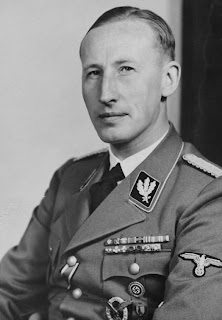
But in The Man with the Iron Heart, Turtledove's sense of inevitable historical patterns which are apt to assert themselves in similar circumstances no matter what the time and place is an unambiguous strength. The "breakpoint" (alternate history lingo for the point at which events diverge from the course they actually took in our own timeline) is the survival of Reinhold Heydrich, the brutal Reichsprotektor of Bohemia and Moravia, who in the real world was assassinated by resistance fighters on May 27, 1942.

One of the architects of the Final Solution (he chaired the 1942 Wannsee Conference, which laid the plans for the removal of all Jews by death or deportation from the German Reich), "Heydrich the Hangman" (pictured above in a photograph by Heinrich Hoffmann from the German Bundesarchiv) was one of the most brutal members of a brutal regime. Hitler considered him as his own possible successor. As efficient as he was ruthless, in Turtledove's story he realizes that the war is lost, and secures Himmler's cooperation in time to prepare a formidable guerilla resistance to the Allied forces which effectively extends World War II for years after Hitler's death and Germany's surrender (in the real world, the "Werewolf" resistance movement was poorly organized and coordinated, and barely survived the end of the war).

You may already have figured out where this is going. No, Harry S Truman isn't foolish enough to land on an aircraft carrier on VE Day and have his picture taken in front of a banner reading "Mission Accomplished." But otherwise, what we have is pretty much a replay of the events following the end of conventional fighting in the Second Gulf War.

American public opinion turns emphatically against the occupation of Germany, to the joy of both Heydrich's Nazi remnant and the Soviets. There's even a Cindy Sheehan figure in the story, the mother of a GI killed on occupation duty well after the signing of the German surrender. Reasoning that Germany is a long way away- and that, besides, we have the atom bomb to protect us- Republican isolationists led, among others, by Sen. Robert A. Taft agitate to bring the boys home. A decisive GOP victory in the 1946 congressional elections and the subsequent cutting off of funds for the occupation ultimately let the National Socialist movement live on even in defeat. The troops are prematurely withdrawn, and at story's end, it is unclear whether the Russians will end up overpowering the prematurely-abandoned West Germany, or whether a resurgent Nazi party will gain the upper hand. What seems clear is that an immature and underdeveloped German democratic culture will likely be stillborn, and that neither the Christian Democratic Union (whose founder, Konrad Adenauer, was assassinated by Heydrich's "Werewolves") or the Social Democratic Party will be able to provide a viable democratic alternative to the two ruthless totalitarian movements to whose mercy Germany- and ultimately Europe itself- has been left by the very same pattern of reasoning which opponents of the Iraq war have espoused, in our own timeline. All the sacrifice and bloodshed of World War II will, in the end, be for nothing- and a war-weary American public is simply to tired and too short-sighted to realize the consequences of its own unwillingness to stay the course.

Nobody but the most ideologically blinded opponent of the war in Iraq questions at this point that the surge worked. Moreover, President-elect Obama has moderated his tone considerably when it comes to just how precipitous he is prepared to be in withdrawing our forces. The Iraqi government itself- which, after all, is made up of people whose necks are on the line- has signed off on a deadline for American withdrawal which it considers feasible. While the American military has its doubts, it might well be that the newborn Iraqi democracy will have a fighting chance to survive after all.

But as is so often the case with his writings, Turtledove's tale of alternate history nevertheless sounds a note of dire warning. It has become a commonplace among the world's bullies that the United States lacks the national will to see a struggle against a determined foreign enemy such as the Iraqi insurgents, the Viet Cong, or Heydrich's "Werewolves" in the novel, through to completion. It's a tale that reminds us just how easy it is to decide that a struggle a long way from home isn't worth the sacrifice and the patience it takes to win it, even when a great deal more is at stake than we're willing to admit.

Jimmy Carter's warped notion of 'human rights'

Remember when Jimmy Carter made "human rights" the hallmark of his essentially regrettable presidency? He's been sounding the same note- and quite sanctimoniously, too- throughout the Bush administration.

But Carter's commitment to human rights seems to be a tad selective. For example, he's waxed quite eloquent of late in defense of the most monstrously murderous regime in all of human history: that of China.

The selective humanitarianism of the left can be an astounding thing.

16 January, 2009

'Nuff said

12 January, 2009

The New York Times out-outs Scooter

Remember the Lame Plame Blame Game? Scooter Libby was eventually convicted for his role in "outing" CIA operative Valarie Plame (wife of foreign service officer Joe Wilson, who allegedly angered the Bush administration by denying- incorrectly, as it turned out- that Saddam Hussein had been seeking yellowcake uranium in Niger). Supposedly the information that Ms. Plame was an undercover agent was leaked to columnist Bob Novak. The problem, of course, is that while the Novak column Plame supporters point to does identify her as a CIA "operative," her undercover status was first mentioned by family friend and liberal columnist David Corn in his column the next day!

There has been a great deal of sanctimony from the left about the impropriety of blowing the cover of an undercover CIA agent. Can't argue with that, actually. But I do find it fascinating that the New York Times today outed an entire series of covert initiatives by the Bush administration against Iran's nuclear program.

I'm listening for the outrage from the same people who were so ticked off at Scooter Libby. But somehow, I doubt that I'll hear much.

10 January, 2009

St. Richard John Neuhaus, 1936-2009

The pro-abortion flag is being planted on the wrong side of the liberal/conservative divide.

-- Missouri Synod Lutheran Pastor and liberal activist Richard John Neuhaus, 1968


He was an anti-Vietnam activist who hobnobbed with the Berrigans, a Missouri Synod Lutheran pastor who transcended the stereotyped attitudes which so frequently characterized those belonging to a church body in which it was possible to go literally from kindergarten through to one's Ph.D without ever attending a school not run by the Synod and populated by conservative, Republican Nordic types demographically identical to oneself.

He was one from whom those few of us in the LCMS whose commitment to just-war theology outweighed the reflexive cultural impulse conservative German Lutherans feel to automatically bless the cannons took inspiration. Later- after the Seminex crisis and the formation of the Evangelical Lutheran Church in America- he was the de facto leader of those of us in the ELCA who still identified with the historic Christian faith, and could not countenance its confusion with any of the various permutations of frank and open Marxism which, under the label "Liberation Theology," so fascinated that denomination.

Where orthodoxy is optional, orthodoxy will sooner or later be proscribed.

-- Richard John Neuhaus, de facto leader of the conservative resistance in the Evangelical Lutheran Church in America, 1997
After my own ordination in 1986, I- an ELCA minister committed to the theology of the Lutheran Confessions- drew courage and inspiration from Neuhaus's insightful, witty and clear-sighted observations in the monthly Forum Letter, a secondary publication of a magazine he edited, the Lutheran Forum. The Forum was, in those days, the voice of the resistance in the ELCA. It would take a while before it became clear that the several strains of Lutherans who were unimpressed with the post-modern direction the ELCA seemed from the beginning to have charted for itself had very little in common other than their dissent from the line of Higgins Road. Catholic wannabes, Pietists, Charismatics, and generic "Evangelicals" there were aplenty in the ELCA- and somehow, still are; those of us who remained committed to the Lutheran Confessions to which we had sworn at our ordinations to conform our teaching and preaching were always few and far between.

But Richard John Neuhaus had a significance which transcended denomination. His book The Naked Public Square soberly and sensibly challenged both the proto-Calvinist view of the religious Right that it was somehow the duty of the Church to dominate the political life of the culture, and the insipid misreading of the Founding Fathers which confused the ideal of the separation of church and state with the impossible goal of separating religion and state. Neuhaus quite properly insisted that there was a great deal of difference between political power on one hand and the prophetic speaking of truth to power on the other, and that it was not only possible but desirable and necessary for America's religious traditions to contribute to our ongoing debate over ethical matters without in any way imposing sectarian beliefs on anybody.

I remember the day when I heard that Pastor Neuhaus had turned Catholic. I was devastated. Even then, I sensed that despite the widespread dissatisfaction among conservative Christians in the ELCA, effective resistance to the leftward ooze of my church body was never going to gel. There was enough dissatisfaction, perhaps, to delay the outright blessing of homosexuality all but guaranteed by the ELCA's early, strategically-worded statements on the subject. But there was not enough theological coherence or simple courage to stem the tide. Whenever Neuhaus or others left ELCA (as I myself eventually did), there was no shortage of people who said that they preferred to stay and fight. Stay, they certainly did; they did precious little fighting, then or since.

I did not agree with Fr. Neuhaus in all aspects of his theology- obviously, since I remain a Lutheran. But I certainly respected his desire to affiliate with something which the ELCA clearly was not, from the moment of its founding onward: a living Christian tradition, standing in some arguable theological continuity with the prophets and the apostles. I understood his decision, at least to a degree, even as I mourned the loss of the only voice within the ELCA which really had the stature and the authority to challenge the nomenkultura in Chicago and the apostate tendency so widely recognized by many in the ELCA, and so sparsely resisted.

The one-time anti-Vietnam activist became religion editor for the National Review. The Lutheran pastor who had won a Catholic award for his editorial arguing that liberal compassion and concern for extending the boundaries of the community and of our compassion to the weakest and the least should make the Democratic party and the left the natural home of the pro-life movement (leaving it to stony-hearted conservatives to coldly dismiss the unborn's claims to humanity) became, as a Catholic priest, one of the most thoughtful and influential of social conservatives. The intellectual big fish in the small pond of the LCMS became one of our best thinkers on the place of religion in public life, an advisor to presidents, and a clergyman whose influence far transcended the Church.

I met Fr. Neuhaus precisely once. He was still Pr. Neuhaus back then. I was serving my first parish in the suburbs of St. Louis, and he was giving a talk at Concordia Seminary. I still remember one line- which I've quoted before in this blog- in which he summarized the position of religion in our national life.

The most religious nation on earth, he observed, was India. The least religious and most materialistic, he continued, was undoubtedly Sweden. America's dilemma, he said, was that we were a country whose people were Indians, but whose cultural elites were Swedes- "and the Indians are getting restless."

They remain restless. But the influence of the Christian faith on the Western world seems to continue its slow ebb. If anything, it's picking up in speed. What a parishioner of mine said back in 1990, when Neuhaus left the ELCA to convert to Catholicism, remains true: the battle is the Lord's, and no one man is indispensable to Him in fighting it.

But he will be missed by all of us, including those who do not know his name. Richard John Neuhaus died of complications of cancer Thursday- surrounded first by friends, and then by angels.

Like Neuhaus, I was an anti-Vietnam Missourian with a concern for civil rights, and another ELCA clergyman compelled to go elsewhere in ordter to retain a living membership in the historic Christian tradition, and also forced by life issues to embrace political conservatism to a degree which I never imagined possible. Consequently I've always tended to identify with the man even when I couldn't agree with him. True, the cause of the Kingdom will not be deterred by his passing, or by the passing of any man. But he will be greatly missed.

09 January, 2009

Conyers' doesn't like Gupta's integrity

In 2007, habitually dishonest left-wing filmmaker Michael Moore did a movie called "SiCKO," in which he indicted the American health care system and compared it unfavorably to that of Cuba.

Health care is one issue on which I am not terribly conservative anymore. Being uninsured for as long as I have, without needed medications, and with only the most tenuous prospect of being able to deal reasonably with even a non-catastrophic illness, a single-payer nationalize plan looks increasingly attractive to me. Philosophically, I strongly believe that access to health care ought not to depend upon one's ability to pay. I feel the same way about justice- and the fact is that in our legal system the ability of the rich to hire the best attorneys and to pay expert witnesses are only two of the ways in which equal protection under the law is more of an ideal than a reality in America.

There remain, to be sure, excellent arguments as to why a single-payer plan would be less than ideal, to say the least. The problems which any attempt to reform the inherent inequities of our legal system would face are even more imposing. Suffice it, in any case, to say that, my social conservatism aside, I am not necessarily disposed to be hostile to the case Moore tried to make in "SiCKO."

Nevertheless, Moore's movie played fast and loose with the facts. The Cuban system to which Moore compared America's is in fact available only to the elite members of Cuba's Communist Party. The health care system the Cuban people have to deal with makes ours look positively utopian by comparison.

In any event, it seems that President-elect Obama's expected nomination of Dr. Sanjay Gupta to be our nation's new Surgeon General is being opposed by leftist Rep. John Conyers (D-Mich).
Molly K. Hooper of The Hill suggests that Gupta's pointed confrontation with Moore over the film on CNN's "Larry King Live" might be the reason for Conyers' opposition.

If, as Conyers claims, Gupta is opposed to universal health insurance, that remains to be seen. And contrary to Paul Krugman, the New York Times blogger alluded to in the story, the argument of Moore's movie was a deeply flawed comparison of an entire nation's health care system with one intended only for a privileged few.

And Moore's reputation as a political extremist complicates the matter. One wonders whether it's his iconic status on the left, rather than Gupta's position on universal health insurance (a position which Mr. Obama surely considered when considering his appointment) which is the real issue here.

HT: Drudge

Blago impeached

No sooner had I alluded to the upcoming impeachment of Illinois Gov. Rod Blagojevich in the previous post than I discovered that it was no longer merely upcoming.

By a vote of 114-1, with one member voting "present," the Illinois House has made Blagojevich the first governor in the long and often corrupt history of my native state to be impeached.

The 59-member Illinois State Senate will convene next week to begin arrangements for the trial. Forty guilty votes will be required to convict Blagojevich and remove him from office. Should this take place, Lieutenant Governor Pat Quinn will take his place.

Franken somehow manages to find the votes

When a statewide race is close enough, nobody will suggest that a recount is not in order. Unfortunately- though the Florida courts in 2000 were selectively cognisant of this fact- recounts are, if anything, often easier to manipulate with fraudulent intent than the original canvass.

Experience teaches that when a Democrat is on the losing end of a close race, it is virtually inevitable that overlooked, uncounted votes should suddenly be discovered, that counted votes should be lost before the recount can be conducted, and that compelling reasons will be found for counting votes previously disqualified for reasonable causes- and quite possibly disqualifying votes previously counted. In Florida in 2000, Republican Secretary of State Katherine Harris had (the cherished Democratic myth to the contrary) no practical control over the initial count. The counties in which supporters of Al Gore claimed irregularities were uniformly Democratic counties in which practical control was exercised by local Democratic election officials. The scapegoating of Harris for the alleged theft of the 2000 Presidential election never made much logical sense. But then, manifestations of Bush Derangement Syndrome rarely do.

The recently concluded recount in the Minnesota Senate race, on the other hand, was under the firm control of the Secretary of State. In this case, it was Democrat Mark Ritchie- "the most progressive secretary of state in the nation," as one left-leaning observer called him. And it is hardly a surprise that Norm Coleman's apparent, narrow victory in the race has been overturned as the result of that recount, and that Democrat Al Franken has emerged as the narrow winner under circumstances which can't help but raise eyebrows among those who remember the mantra of the 2000 Gore campaign in Florida: the appeal that "all the votes be counted."

If the Coleman campaign is right, some of the votes- cast for Franken- were counted more than once in the recount, while other Coleman ballots which should have been counted were thrown out for no adequate reason. While a legal battle seems likely to continue for some time, the Minnesota Board of Elections has certified Franken as the victor by a margin of 225 votes out of about two and a half million cast.

Neither party has a monopoly on either electoral virtue or electoral vice. Republicans and Democrats alike cheat in elections, and always have. Not all Republicans cheat. Not all Democrats cheat. While the only study I recall having seen on the topic- conducted in 2004- concluded that Democrats were statistically more likely to cheat in that particular election than Republicans, it is nothing less than silly to suggest that, in the last analysis, either party is either more corrupt or more virtuous than the other.

But given the partisan divisions in this country, it is inevitable that the normal doubt which arises when an election night result is overturned by a recount conducted under circumstances favoring the candidate who eventually wins, in the face of what his opponent regards as gross irregularities, should morph into the conviction on the part of the loser that the election was stolen. And when- as is so often the case today for people on both sides of the political divide- people have so completely lost their sense of proportion that they have convinced themselves that those on the other side are utterly and completely evil, and that only those on the other side ever commit vote fraud. That this view should be as prominent especially on the left as it seems to be is not a healthy sign for American democracy.

When Republicans cheat in elections, they tend to disenfranchise people. When Democrats cheat in elections, votes which should not have been counted (usually either because they were cast illegally, or because the people who supposedly cast them never really existed) end up getting counted- sometimes more than once. Probably more common than outright fraud in both parties is the manifestation of an attitude a congressman once famously displayed when informed that the case involving a seat to which both candidates attempted to submit credentials of election was "a case of two damned scoundrels."

"Yes," he replied. "But which is our damned scoundrel?" Especially in dubious cases, partisan advantage rather than regard for the people's will can often tip the balance when it comes to which of two damned scoundrels- or even two honorable men caught up in a closely-contested campaign where the legitimate winner is in real doubt- ends up on top. And it would be naive to suggest that, except perhaps in the most clear-cut cases, partisan advantage does not usually end up determining which way even honorable people view ambivalent evidence.

The battle for the Minnesota Senate seat isn't over yet. The Coleman campaign will take it to the courts. But it seems certain that whoever ends up being seated- and all the odds seem at present to favor Franken, especially given the Democrats' strong control over the Senate which is, after all, the final judge of its own elections- will serve under a cloud.

And if the apparent result holds up, the State of Minnesota- once the laughingstock of the nation for electing Jesse Ventura as its governor- will now have to suffer the ignominy of being represented in Washington by a nasty, self-righteous, not-very-funny comedian whose untruthful books about those he disagrees with politically have contributed at least as much as the writings of Ann Coulter, Rush Limbaugh, and the others on the Right he disparages to the atmosphere of ugly hate and partisan rancor which so blights our politics.

Roland Burris, appointed by soon-to-be-impeached Illinois Gov. Rod Blagojevich to fill President-elect Obama's Senate seat, may or may not eventually be seated; there have been indications of late that Harry Reid and the Democratic caucus may accept his credentials after all. But Burris will not be the only new senator to take office under a cloud. If the apparent result holds, Franken will, too.

That cloud will consist, to be sure, of the result of a recount concerning whose integrity there are serious questions. But more than that, he will take office under the cloud of being Al Franken- one of the people most responsible for the poisoning of American politics over the past eight years.

And Minnesota will once again find itself under a cloud as well, as a state whose selection of Franken- be it by ever so small and even questionable a margin- does no great credit to its reputation for wisdom, reason, or decency.

08 January, 2009

Crichton merited a better sendoff

Michael Crichton- who, as the LA Times once observed, was probably the only man ever "to have a No. 1 book, No. 1 movie and No. 1 TV show all at the same time,” died on Election Day. That's no doubt one reason why his passing received less attention than one would expect for the death of the guy responsible for both Jurassic Park and ER.

But TIME omitted Crichton from its tribute to those who made news- whether by dying or otherwise- in 2008, and the media generally seem to have had surprisingly little to say about the death of a man who had such a profound impact on the popular culture.

Could the reason be his skepticism about the catastrophic view of global warming so devoutly espoused by the media, Hollywood, and the other moguls of the popular culture?

For his best-known book, Jurassic Park, Crichton invented a fascinating and even compelling, but highly fictionalized, "villain:" Velociraptor, an admittedly vicious dino which, in reality, weighed only about seventy-five pounds and was the size of a small dog. Nor- contrary to the story line- was Velociraptor anywhere near as intelligent as dolphins or other mammals; while the real Velociraptor might have had more brains than your average dinosaur, that doesn't say much. Dinosaurs as a class were hardly mental giants, and Crichton simply gave Velociraptor too much credit.

But for whatever reason, the media seem to have done the same thing in reverse to Crichton, shrinking his importance to the popular culture in death to a size far smaller than he merits.

HT: Real Clear Politics