30 July, 2010

'This blessed martyr, St. Robertus'

Today is the 470th anniversary of the martyrdom of Robert Barnes, English Lutheran reformer and personal friend of Luther.

Barnes, who had served as an Augustinian prior, was one of the Cambridge scholars who gathered at the White Horse Inn for theological study and discussion. He received his Doctor of Divinity degree in 1523, and was arrested and brought before Cardinal Wolsey for preaching a Lutheran sermon in 1526. Given the choice of recanting or being burned at the stake, Barnes chose the former, and was committed once again to the Augustinian monastery. He escaped to Antwerp, however, and proceeded from there to Wittenberg, where he met Luther and was a guest in his home. While there, he also made the acquaintance of Stephen Vaughn, an agent of Thomas Cromwell. Barnes made a good impression on Vaughn, who recommended him to Cromwell. Commenting on a book Barnes had written, he wrote prophetically to the Protestant who would replace Wolsey as Henry VIII's chancellor, "Look well. It is such a piece of work as I have not yet seen any like it. I think he shall seal it with his blood."

Barnes became one of the intermediaries between Luther and the princes who supported him on one hand, and Henry VIII on the other. He was sent by Henry to Wittenberg to attempt to obtain Luther's support for his divorce from Catherine of Aragon. His mission failed miserably; Luther- with his typical lack of diplomacy- began his letter to the newly divorced and remarried Henry, "Martin Luther, by the grace of God minister at Wittenberg, to Henry, to the disgrace of God King of England, greetings."

Forced again to apologize and recant after attacking Catholic Bishop Stephen Gardiner, Barnes reverted to Lutheranism when Cromwell was made Earl of Essex and Bishop Sampson, one of Gardiner's closest friends, was sent to the tower. But the king's disastrous marriage to Anne of Cleves sealed the fate of both Cromwell and Barnes. Cromwell was deposed, and on July 30, 1540 Barnes was burned at the stake at Smithfield, London. Fellow Lutherans William Jerome and Thomas Gerrard were burned with him. Catholics Thomas Abel, William Fetherstone and Edward Powell were hanged for treason in denying Henry's claim to be head of the English church at the same time.

Barnes- not always the most tactful man during his life- died with sublime courage. His eloquent final words proclaimed his firm adherence to the doctrine of justification by grace alone, through faith alone, for Christ's sake alone, and scores of onlookers were said to have been converted to Lutheranism by his words and by the manner of his death. When word reached Wittenberg, Luther openly mourned the passing of the man he called "this blessed martyr, St. Robertus."

Seldom remembered today, and like all of the Lutheran martyrs for some reason omitted from the Lutheran calendar, Barnes remains an outstanding figure in the history of the English Reformation and of the Lutheran church. His story should be more widely known.

HT: NNDB.com

29 July, 2010

Gouda for him!

A Dutch brewer claims to have brewed the world's strongest beer.

27 July, 2010

Harrison on the LCMS and inter-Lutheran cooperation


A short interview with LCMS President-Elect Matthew Harrison on his plans for the LCMS and on the short-term future of inter-Lutheran relationships.

T-Paw makes his case


He's not Palin. He's not Romney. And most of all, he's not Obama.

26 July, 2010

Howard is still being Howard

It's not just that 'racist' is such an ugly word. It's an important concept in a society with a history as stained with racism as ours. That's why it's so tragic when it's trivialized by inappropriate use, whether the NAACP's recent slander of the Tea Party Movement itself (and not merely a minority of its members) as racist, or former Vermont Gov. Howard "I Have a Scream" Dean's slanderous use of the term to describe the recent reporting of Fox News on the admittedly grotesque Shirley Sherrod incident.

23 July, 2010

Go, Cubs, Go!

I posted a Steve Goodman video yesterday. It seems only fitting, on a day when the Cubs beat the Cardinals, to post another Steve Goodman classic.

22 July, 2010

A classic song from my past

Lincoln Towing is a business concern in Chicago, where there are far more cars than parking places and a good buck to be made by impounding cars thought to be parked illegally, or something.

Below is the late Steve Goodman singing a song- local mid-Seventies references and all- that really makes me nostalgic for my home town.

But not for parking on the North Side.

21 July, 2010

Quinnipiac: Generic Republican would beat Obama

A Quinnipiac University poll shows that an unnamed Republican would defeat President Obama by ten points in 2012.

According to the poll, eight percent more think that Mr. Obama does not deserve a second term than say that he does .

By a ten point margin, Americans think that Mr. Obama has been a better president than George W. Bush. But by a two point margin, they think that the country would be better off had John McCain defeated Mr. Obama in 2008.

HT: Drudge

20 July, 2010

Leftist media conspired to kill stories about Obama's goofy pastor


An interesting piece of investigative journalism here on how several of the best-known liberal media outlets- including some on-line- conspired to kill the story about President Obama's nutty, racist long-time pastor, the Rev. Jeremiah Wright, during the last presidential campaign.
Stories about Wright, whose anti-white, anti-American Sunday morning tirades had gone on for years, emerged at a time when the media were trying hard to sell the idea that Obama- whose voting record was among the farthest Left of any member of the U.S. Senate- was in fact a moderate. The effort continues to this day. Wright had baptized Obama's children and served as his minister for twenty years.

The outrage among the supposedly objective media was fascinating, especially given the eagerness with which it snapped up any damaging rumor about George W. Bush four years before- including the false story the reporting of which ended Dan Rather's career at CBS.

HT: Real Clear Politics

19 July, 2010

Joe Morgan: Santo, Wills belong in HOF. No kidding!


Hall of Fame second baseman Joe Morgan has a reputation- a very understandable reputation, from what I've heard from him over the years- as a Cub hater. That's why it's so surprising that he's come out strongly for Ron Santo's much-belated admission to the Hall.

It's ridiculous that Santo- probably one of the five best third basemen ever to play the game- wasn't admitted to the Hall years ago. He has the credentials. He has the numbers. And I have to agree with Morgan about something else: it's at least as absurd that Maury Wills wasn't elected to the Hall years ago.

18 July, 2010

The Tenth Doctor" is degenerating, as well as regenerating


I saw "The Waters of Mars" last night.

Appearances to the contrary, it is not a tale about some extraterrestrial branch of my family. Instead it's a BBC special episode of Doctor Who, laying the groundwork for the demise of the Tenth Doctor (David Tennant) and his regeneration into the Eleventh (Matt Smith).

Impressive. The Tenth Doctor- my favorite, and that of most Whovians, it seems- is clearly losing it. His hubris is contaminating his decisions, and his psychological deterioration is preparing the way for his coming regeneration in a manner unprecedented in the half-century history of the series.

Dr. Who has certainly come a long way since the charming but cheesy British series that debuted on the night that JFK was assassinated. It's become one of the best things on television, from the point of view of plot and writing as well as simple fun.

17 July, 2010

Further reflectons on Uwe Siemon-Netto, Gen. Giap and recent American wars


"No matter how well we do on the battlefield, some day we're going to have to go home- and they're still going to be there."

--Unidentified junior NSA staffer to National Security Advisor Walt Rostow on why he was not cheered by "good news" from Vietnam. Cited by David Halberstam in The Best and the Brightest
I recently blogged on a piece by Uwe Siemon-Netto on the insight into the democratic psyche which led North Vietnam's Gen.Vo Ngyen Giap to victory over the United States in the Vietnam War. Upon further reflection, though, it seems to me that two caveats need to be added to the point that democratic societies- as demonstrated by the Vietnam debacle, the current debate over our involvement in Afghanistan, and even our apparent victory in Iraq- lack the stomach for long-term sacrifice and commitment necessary to win conflicts not obviously and immediately related to their own national survival.

One of my pet peeves when it comes to Vietnam is the myth- quite popular in conservative circles, both in the United States and elsewhere- that if only we somehow had summoned the will to continue our commitment, we could have won there. That view demonstrates an utter failure to appreciate the nature of both our involvement and the real reason why it failed.

We never decided to fight a war in Vietnam. There was never a "Pearl Harbor moment," a conscious summoning of the national resolve to pay a recognized price to achieve a specific and clearly-visualized result. Rather, what we signed on for was a supportive role in a struggle in which we would theoretically help others to win a victory which was, in the last analysis, theirs, and not ours, to win. In Vietnam- as proved not to be the case in Iraq, but may well be the case in Afghanistan-we set out to help someone else fight a war, and ended up fighting it ourselves. The fact that the struggle degenerated into a war between the United States on one hand (with South Vietnam playing a secondary role) and the North Vietnamese and Viet Cong on the other is what doomed us. At no point did we bargain for such a struggle. Instead, the idea was always that it would be the United States which would play the secondary and supporting role, and the South Vietnamese, who- as even Lyndon Johnson at his most detached from reality was lucid enough to observe- would finally have to win or lose the war themselves.

It was advisers, and not combat troops as such , which the United States initially sent to Vietnam. Our status there morphed into the role of major combatant, rather than merely supporter of the South Vietnamese, over time and despite our own intentions. The "advisers" wound up actually waging the war. while a series of corrupt, incompetent, and less than democratic regimes in Saigon utterly failed to hold up their end of the bargain.

To understand why, it is necessary to review a history with which Americans- especially on the Right- are mostly unacquainted. It's important to bear in mind that while there was precedent in the history of Indochina for Vietnam to be split into three national entities- Annam, Tonkin, and Cochin China were their traditional designations- there was no real basis for dividing it into two. Neither ethnic, historic, or political justification existed for such an entity as South Vietnam. Migrations throughout the area had so blended the ethnic, religious and cultural demography of the region that it would be hard to see any but the most arbitrary basis for treating the region as anything but that which the French had treated it as throughout their long colonial rule there: a single entity, French Indochina.

When Ho Chi Minh and Gen. Giap defeated the French at Dien Ben Phu, it is certainly the case that their ideological Communism was a major issue in the South, where a large Catholic population helped make the population less receptive to the ideology of the Viet Minh than they were north of the Seventeenth Parallel.. The 1954 Geneva Accords contemplated a plebiscite throughout the region to decide whether a truce line at the Seventeenth Parallel should become an international border, and a wholly new entity- South Vietnam- would be created, more for ideological than for ethnic or historic reasons.

It is true that the South was less populous than the North, and that a plebiscite throughout the whole Vietnamese nation would likely have been decided by the way the vote went in the North. In a totalitarian state, there was little doubt as to how the vote would go there. Despite provisions for the plebiscite to be internationally supervised, the West viewed the possibility of a fair outcome with grave suspicion. Yet one glaring fact remains, and cannot be overlooked: both President Eisenhower and President Kennedy conceded quite frankly that had the plebiscite been held, and held freely, Ho and the Viet Minh would have won a crushing majority. President Eisenhower actually estimated that majority at at least ninety percent.

The North's greater population would not have decided a fair plebiscite. The national aspirations of a third-world people long colonized by the West would have been the decisive factor. The "nation" of South Vietnam was a wholly artificial entity, finally arising out of the will, not of the South Vietnamese, but of the United States and the West, which managed to ensure that the plebiscite was never held. In the last analysis, we lost in Vietnam because the people of South Vietnam never developed the national will (or identity) to win the war even with our help. The problem was not, as the Siemon-Netto article seems to suggest, that the United States experienced a failure of the will; we never contemplated being one of the main combatants in a long-term war in the first place. Our role from the beginning was, as we saw it, to provide support to the South Vietnamese in a struggle which, in the last analysis, they never had anything resembling the requisite will to win.

Could the South have finally triumphed if only we had held out a year or two longer, and not cut off our support? Perhaps. But I see no convincing evidence to that effect. We will never know whether the South would have summoned the will to win the war had our support for them continued at previous levels for a few years more. One thing is sure, though: the North Vietnamese and the Viet Cong would still have been there no matter when we left, and unless the South Vietnamese as a people cared enough to alter it by their own efforts, the result of the war would have been the same.
To assume that for some reason this would suddenly and miraculously have happened if only we had stuck around a little longer smacks of the kind of rationalization which defeated nations often find- if necessary creating them out of whole cloth- in the face of humiliating defeats. Which brings us to the second caveat: the conservative myth to the contrary, the defeat of the United States in Vietnam was no more than Germany's defeat in World War I the result of being "stabbed in the back" at home. It was finally due to the failure of the Saigon regime to rally the people of South Vietnam behind it strongly enough to make South Vietnam- from the beginning an artificial state- a viable nation.

We need to be very clear about this: in Iraq and Afghanistan, as in Vietnam, the United States went to war, not to fight as a major combatant, but rather to provide support for indigenous forces which would finally have to create a national government with our help, and rally the nation's people to victory. Our apparent victory in Iraq is due to the fact that, against all odds and despite the predictions of practically everyone when the war began, the Iraqi people have apparently succeeded- enabling us, in turn, to succeed in the mission we originally signed on for. Our stomach for a protracted conflict was beside the point: the point is that our engagement in Iraq, in Afghanistan, and in Vietnam was predicated on the assumption that such a conflict would be unnecessary; that our presence, rather than being required to actually win the war, would merely create the conditions under which our allies could win it. Our defeat in Vietnam- and the currently dubious state of affair in Afghanistan- both came out of situations in which native governments were not able to achieve what the people and the new, democratic government of Iraq achieved: the creation of a stable and competent national authority able to rally the nation behind it and assume the major responsibility for the final outcome which the initial American involvement was intended, not to achieve, but merely to enable. We were defeated in Vietnam, as we well may be in Iraq, by having as our ally a regime (or series of regimes) more dedicated to personal enrichment than the development of national institutions, and animated not by idealism but by pervasive and cynical corruption.

The late Chicago columnist Mike Royko once suggested that the city motto of my home town- Urbs in horto ("City in a Garden") should be changed to Ubi est mea? ("Where's mine?"). The latter was the E pluribus unam of South Vietnam, just as it shows depressing signs of having become that of Afghanistan.

I think that there remains a lesson to be learned from Gen. Giap's observation about democracies lacking the stomach for long, drawn-out wars in which their national security is not in dramatic and immediate danger- but not, perhaps, exactly the lesson Uwe Siemon-Netto draws from it. True enough, our enemies, from the Taliban to Osama bin Laden, have made no secret of the fact that they are counting on precisely the weakness in the democratic will to which Gen. Giap pointed to enable them to triumph over us. The larger picture- the ongoing struggle against Islamofascism over the decades, as contrasted with the immediate military situation in Afghanistan or any other specific theatre of that struggle- demands that we ourselves be aware of the tendency of democratic societies to lose their stomach for what can come to seem individually to be mere brush fire wars, fought on the opposite side of the globe to no end which immediately seems to affect us either way back home. That tendency is a grievous danger. Well does Siemon-Netto warn us that unless we combat it, it may well prove our undoing in the long-term struggle with the enemies of freedom and American values which, the siren song of isolationism to the contrary, is simply not a struggle we can forgo.

But the real danger the Vietnam experience should warn us against is that of "mission creep." It is one thing to support a viable potential democratic nation in its struggle for freedom, if only as a hard-headed measure to counteract the global machinations of our adversaries. But "nation-building" is a dicey enterprise. It seems to have succeeded in Iraq. It failed in Vietnam, and its success or failure in Afghanistan remains open to question.

We need to count the cost before going to war, to have our goals clear in our own minds, and be absolutely certain that they are modest enough to be achievable before the phenomenon Gen. Giap wrote about can set in. Given the cost our nation selflessly paid in Vietnam for the sake of those who simply did not value their own cause as strongly as we did, to accuse the United States of having not done enough is not merely wrong-headed. It is not merely silly. It borders on the obscene. It is an insult to the cost we did pay, and can only come of a skewed, revisionist, and fundamentally unjust reading of history.

The fundamental lesson of Vietnam- and of Iraq and perhaps Afghanistan as well- is not that we are psychologically unfit to wage geopolitical war against the enemies of freedom and of our own national interest, suffering from a kind of national ADHD which deprives us of the ability to see our military efforts through. It is that that our decision to involve ourselves in such wars needs at every stage to involve what the war in Vietnam classically did not involve: a conscious, thoughtful commitment rooted in a realistic and pragmatic assessment of what the cost is going to be, a conscious and lucid national decision to pay that cost- and a judicious assessment of whether the will and the institutions of those on whose behalf we send our young men and women into harms way are sufficient to enable them to achieve with our help a victory which it is finally theirs, and not ours, to win.

15 July, 2010

Matt Harrison and the Two Kingdoms


Confessional Lutherans are rejoicing at the election of the Rev. Matthew Harrison as the new president of the Lutheran Church-Missouri Synod. At long last, the United States will once again have a major denomination presenting itself to the world as traditionally Lutheran.

I expect the LCMS to once again take on a... well, Lutheran flavor now. The Means of Grace will, at least officially, once again be the tools Missouri officially endorses for sharing Christ and His blessings, instead of human marketing and psychological manipulation. Small groups replacing Word and Sacrament ministry as the focus of the congregation's life, "contemporary" worship, the Ablaze!(c) "movement," and suchlike will no doubt continue, but at least such Reformed-style resorts to human manipulation in the place of a Lutheran reliance on the Means of Grace in the promulgation of the Gospel will no longer have the Synod's official endorsement. Hopefully Ablaze!(c) will, to coin a phrase, come to have some "Lutheran substance," or else be phased out in favor of something that will. We can certainly do without the "Evangelical style" which has come to characterize the face Missouri shows the world. "Lex orandi, lex credendi," as St. Vincent of Lerins once famously remarked; "the law of prayer is the law of faith." We come to believe what we pray- and how we pray. Sooner or later "Evangelical style" becomes "Evangelical" substance- or lack thereof. If we worship like Baptists, and encourage our laity to think of themselves as a part of the "Evangelical" movement in the modern American rather than in the traditional Lutheran sense of the word "evangelical," then Baptists will be what they will become. Baptists, perhaps, with a high view of the Sacraments, but Baptists nonetheless.

We believe what we pray. Best to pray the words of Scripture, in the form handed down to us from the catacombs in the historic liturgy of the Western Church, and in musical forms suited to the dignity and the majesty of the subject matter. In music, too, "the law of prayer is the law of faith." We should not be surprised when the resort to praise bands leads to a view of Jesus as homeboy, just as when the use of the Lutheran chorale evokes a sense of Him as Lord and Savior. We should not be surprised when the bad theology of contemporary Christian music leads to misbelief, error, and spiritual misery.

But still, it must be said that, strictly speaking, musical style is an adiaphoron. So are small groups, and many of the other dubiously Lutheran innovations which have become common in Missouri over the past nine years and more. Praise bands may actually be of dubious utility in outreach, and counterproductive in the long run, but their use, per se, is not sinful. They are also less popular with those we would like to reach than their advocates maintain, and less useful in reaching them- but that is another story.

Hopefully that's the sort of thing President-elect Harrison had in mind when he said in his address to the convention just after being elected that "I will not coerce you." From everything I've heard of the new LCMS president, he is a persuader rather than a coercer, a healer rather than a warrior, a pastor rather than a pendant. Good for him. As one myself who sometimes has a tendency to shout and hurl anathamas when quiet persuasion would be both more effective and more appropriate, I can only admire that quality in Matt Harrison.

But not everything that has divided Missouri and American Lutheranism in the past several years can be dismissed as an adiaphoron. Outgoing President Gerald Kieshnick has, to his credit, been eloquent and forthright in speaking the truth in love to the ELCA, for example, on matters of human sexuality, and as an advocate for the unborn. But other issues are going to require something more than quiet persuasion. The widespread practice of open communion among LCMS congregations, representing not only a refusal to "walk together" with a Synod which remains committed to the apostolic practice of closed communion but a defiance of the salutary practice of the Church of the ages, is going to require more from the new LCMS presidium than evangelical persuasion.

I continue to be amazed how many Lutherans- and Lutherans who should know better- confuse Luther's distinction between God's Two Kingdoms with the seperation of Church and State. Actually, it has far more to do with the distinction between Law and Gospel. While it's true that the Kingdom of the Right Hand- the Kingdom of Grace, where no coercion is required and the New Self freely serves God and neighbor out of spontaneous and wholly uncoerced love- is found only in the Church, the Kingdom of the Left Hand is found in the Church as well as in the State. The Church is the Kingdom of the Right only insofar as it consists of the New Selves of its members- the justus as opposed ot the peccator, the saint as opposed to the sinner. But alas, Christians are simul justus et peccator- at the same time saints and sinners. The error the ELCA makes when it mistakenly treats the Gospel in its narrow form- the doctrine of justification- as the "Gospel" of which the Seventh Article of the Augsburg Confession speaks when it says that is enough for the Church's unity that there be agreement on the Gospel and the adminstration of the Sacraments is a deadly one. The Gospel of which Melanchthon writes is the Gospel in the broad sense- the Law as well as the Gospel. In practice, even the ELCA would not argue that the unity of the Church would not be disrupted by the participation of its members in genocide or their conscious and intentional embrace of racism, for example. Even the ELCA, in practice, embraces the presence within the Church of the Kingdom of the Left Hand as well as the Kingdom of the Right; any ELCA pastor who doubts this should try insisting publicly that 1 Timothy 2:12 means what it says with regard to the issue of women's ordination, or that words which are used throughout Greek literature to denote purely consensual sexual relationships between people of the same gender do not suddenly come to refer only to coercive ones when used by the Apostle Paul to describe behavior which excludes one from the Kingdom of God.

Rev. Harrison, as a pastor, will certainly have the responsibility to teach, to exhort, and to persuade. But the sorry confessional situation of the LCMS today calls for more than that. As synodical president, Rev. Harrison, the presidium as a whole, and the district presidents also have the responsibilty to function in God's Kingdom of the Left Hand. When it comes to the practice of open communion, for example, or actual doctrinal deviation (as distinct from theologically dubious practices which strictly speaking can be defended as adiaphora), President Harrison will have to break the pledge President-elect Harrison made to the convention the other day. He is going to have to coerce. He is going to have to insist that it's going to be the Lord's way, or the highway.

And I have no doubt that he will. I have not the slightest doubt that when he promised not to coerce the people of the Missouri Synod, he was thinking of matters in which pastoral persuasion is an option.

When I was a pastor in the ELCA, I used to imagine that in confessional congregations both in Missouri and elsewhere it was, if not easy, at least practical for pastors to readily fulfil their responsibilities in the Kingdom of the Left Hand- the exercise of that precisely coercive authority which we would all like to avoid, but which sometimes cannot be avoided. I've written before in this blog of my admiration for my pastor at Grace in Chicago, the Rev. Roy Bleick, who- in the face of a blatantly racist decision by the parish school board not to admit a little girl to our parochial school because of the color of her skin, effectively placed us all under the interdict and refused to preside at communion until that sin was repented of and rectified. All of us like to imagine ourselves as courageous heroes standing up to evil in the Lord's Name and facing it down, the way Pastor Bleick did.

But it has many times fallen to me in my years as a pastor to speak the truth in love to those who have fallen into gross and public sin. There is nothing that is harder to do. And in this day and age, even our congregations- whatever they may confess about the Office of the Keys in principle- in practice are heavily influenced by a culture which echos the words of the jury foreman who several years ago explained a verdict awarding a substantial sum in a lawsuit brought by a woman who had been quite appropriately excommunicated by her congregation for gross, public, and defiantly unrepented sin (though it should be noted that the congregation had handled the matter very badly): "I just don't see what business the Church has telling people how to live."

"Cracking the whip" can be hard. It can also sometimes not be the most effective way to handle a situation. In remembering Pastor Bleick's faithful stand against the corporate sin of our congregation, I also recall the story about St. Ambrose, who supposedly received a report that an presbyter was consorting at that very moment with a prostitute by leading the entire presbyteriate to the man's home, walking at a fast enough pace to outdistance them and making enough of a ruckus that the man and the prostitute saw him coming. Opening the door just a she took refuge within a trunk at the foot of the man's bed, Ambrose sat upon the trunk before ordering the presbyters to search the house for the woman- and then having failed, of course, to find her, had each one in turn shake the man's hand and humbly apologize for ever having thought him capable of such a thing.

One by one, they left. Finally Ambrose left, too- after knocking on the top of the chest, saying, "You can come out now," and departing without another word.

Throughout all my years in the parish, I hoped that some day I'd be that good. Regrettably, though, I never came close. I always struggled with the twin temptations to be a coward and a scold, and tried- awkwardly and not always successfully- to find a middle way.

In this age of the deified individual, in which private opinion is granted a degree of reverence once reserved for divine revelation, it isn't easy to do the job of pastoring in the Kingdom of the Left Hand. And as Dr. Quere, my seminary advisor, once pointed out, there would be something very wrong with any pastor who did not hate having to do it.

But it is part of the pastor's job. It has to be done precisely for the sake of the Gospel, which is only Good News in the face of the Bad News of the Law. And that's as true in the arena of doctrinal supervision as it is in the parish, serving as God's local source for the word of forgiveness and life we sinners so desperately need.

Why hasn't the Pope excommunicated all those pro-choice Catholic politicians? Probably for the same reason it's so hard for a faithful pastor these days to deal with a couple in the congregation whom he learns is living together only when they come to him- grudgingly- for pre-marital counselling. One is as gentle and as evangelical, in the best sense of the word, as one can be. The goal is to regain the sinner, not to cut him off.

But President Harrison, like every pastor, is going to find that sometimes he's not going to get to be evangelical. Sometimes, he's going to have to coerce. And he knows that. Every pastor finds it out very quickly, if he didn't know it going in.

One thing is sure: I wouldn't want the job Matt Harrison has just been elected to. Cleaning up the mess that is the Missouri Synod is a job I wouldn't wish on anybody, especially in a day in which biblical and theological ignorance combine so powerfully with the cult of individual freedom and choice to make even those of us who think of ourselves as committed Christians less willing than ever before to listen to pastoral persuasion.

No, I wouldn't want that job. But for that very reason, I'll pray that God helps him to be a the pastor we all are hoping for, and which the Missouri Synod so desperately needs- and the teacher, too. To be both, and at the same time, he is going to need all the prayers he can get.

God help you, Pastor Harrison. And God be with you.

14 July, 2010

About time we internalized this lesson


Lutheran Journalist Uwe Siemon-Netto blogs on North Vietnamese General Vo Nguyen Giap's insight on the fatal flaw in the psychology of democracies when it comes to fighting long, drawn-out wars.

Giap parlayed this insight into victories over both France and the United States. He was one totalitarian who certainly had the number of the democracies. Osama bin Laden, the Taliban, and the other Islamofascists are counting on him being proven right once again today.

Like the man says: He who fails to learn from history is doomed to repeat it.

And repeat it. And repeat it. And repeat it....

Harrison election and address to LCMS convention

Remember when Obama's people said that Obamacare wouldn't lead to government-financed abortions?

They lied.

So much for Executive Orders.

HT: Drudge

13 July, 2010

Traditional Lutheran elected Missouri Synod president!

The church body in which I was baptized and confirmed took a major step toward becoming "your grandfather's Missouri Synod" again today.

The Reverend Matt Harrison, a confessional Lutheran, has been elected as the president of what was once a traditional Lutheran denomination, and which may soon be one again.

Harrison, who has served as the executive director of LCMS World Relief and Human Care since 2001, received 643 percent votes, or 54 percent, on the first ballot this afternoon. Incumbent President Gerald B. Kieschnick received 527 votes, or 45 percent. The Rev. Herbert C. Mueller Jr was elected First Vice President, receiving 631 votes, or 53 percent, to 339 votes, or 28 percent, for incumbent Dr. William Diekelman.

In 2001, following the death of confessional President Alvin Barry, Texas District President Kieschnick was narrowly and unexpectedly elected president to head the denomination, "sneaking in" between two confessional candidates some of whose supporters had been engaged in nasty intramural infighting. Kieschnick- the candidate of groups called "Daystar" and "Jesus First," dedicated to making the LCMS more of a mainstream "Evangelical" denomination in one hand and a more ecumenical, less confessionally Lutheran denomination on the other- made the celebrated comment that "this is not your grandfather's Missouri Synod" shortly after his election. Denying in a radio interview that Lutherans believed in baptismal regeneration, he also supported the decision by Atlantic District President Dr. David Benhke to lead a group of assorted Christians, Jews, Muslims, Sikhs and other worshipers of various and sundry deities in prayer at an joint service held at Yankee Stadium in the wake of the 9/11 attacks. His supporters maintained that this was acceptable because it was an exceptional situation, and because Behnke added "in Jesus' precious name" at the end of his prayer. The resulting controversy led to the ouster of Lutheran Hour Speaker Wallace Schultz, who as First Vice President of the Synod was the highest ranking officer not involved in the decision, and thus placed in the position of disciplining Behnke. Schulz's suspension of Behnke was ultimately overturned.

Kieschnick presided over a period of decline for the Missouri Synod, despite claims by his supporters that endorsement of Baptist-style "contemporary worship" and the theologically un-Lutheran Ablaze! "movement" or program (which downplayed Lutheran teaching that people are brought to Christ through the Word and the Sacraments and emphasized human marketing programs and other efforts more in keeping with Reformed "Evangelical" theology), would make the Missouri Synod more accessible to mainstream Americans and reverse previous membership losses. Denying the fact that open communion,- a practice contrary both to traditional Lutheran and official Missouri teaching- was being widely practiced in the LCMS, President Kieschnick frustrated confessional Lutherans who protested the practice.

I was baptized and confirmed at Grace Lutheran Church at 28th Street and Karlov Avenue in Chicago. My family joined the LCMS when I was ten years old, and my sister and I graduated from Grace's parochial school. I eventually left because, although I could not have articulated this at the time, already then I had a sense that Missouri was becoming more and more an"evangelical" denomination with a high view of the Sacraments rather than a theologically solid Lutheran communion rooted in the Word of God. In retrospect, widespread difficulty among LCMS pastors and teachers in distinguishing between Law and Gospel also led to my increasing sense of alienation from Missouri.

When I went to seminary, it was to an institution of The American Lutheran Church, Wartburg in Dubuque. Regrettably, the theology  I found there- while less inclined to the legalistic tendencies I'd encountered in Missouri- was even less Lutheran, if judged by the theology of the Confessions and Luther himself. I soon discovered that I had little in common theologically with most of my collegues in the ministerium of first The ALC and then the ELCA, and that the laity had an even stronger bent toward Pietism and Reformed-style "evangelical" legalism than I'd encountered in the LCMS .

I rejoined Missouri after leaving the ELCA. I was married in a Missouri congregation where, with the District President's approval, I later served as a supply preacher. I belonged to that congregation and a second one in a neighboring district from then until I accepted a call to become pastor of Saint Mary Evangelical Lutheran Church, an independent confessional congregation in Des Moines.

While a member of that second LCMS congregation I had begun the colloquy process to become a member of the LCMS ministerium. While I was approved, for a variety of reasons- some financial- I did not pursue the matter further. I don't know whether I will nor not at this point; after all, there isn't much call, or many calls, for sixty year-old pastors. But having asked for and received a release from my call at Saint Mary in April, the election of Rev. Harrison as LCMS president gives me a clear sense that I have a home to which I can now return.

Whether as a pastor or, more likely, as a layman, I'm returning to Missouri. My own grandfather wasn't even a Lutheran. But once again, I have reason to hope that even if it's not my grandfather's Missouri Synod, the LCMS may once again be mine.


ACL Conference with Pastor Matt Harrison from Norm Fisher on Vimeo.


ACL Conference with Pastor Matt Harrison, Part 2 from Norm Fisher on Vimeo.

HT: LCMS Reporter On Line

12 July, 2010

Hawks keep Hammer- but was this "rope-a-dope" by Sharks' Wilson?


The Blackhawks have matched the Sharks' offer to defenseman Niklas Hjalmarsson.

While I'm glad that Hammer will be back next year, the four year, $14 million contract means that the salary cap problem is back again. People are even saying crazy things about trading Antti Niemi, or letting him walk. Personally, I don't have enough faith in Corey Crawford or Cristobel Huet to even want to think about that. Of course, the could go out and pick up somebody like Tomas Vokun on the cheap. But how cheap would he be?

I really have to wonder whether Sharks GM and former Hawk star Doug Wilson ever really intended to sign Hammer to more than an offer sheet. After all, he's put the Sharks' chief rival in the Western Conference back up against the salary cap again by signing that offer sheet. Especially given the Sharks' own cap problems, I wonder whether that might not be what he had in mind all along.

If so, a hat tip to Doug- and a discouraged shake of the head to Stan Bowman, his opposite number with the champs.

"God told me." "Says who?"

A layperson at the LCMS convention in Houston has informed that august assemblage that his vote on a particular issue (which one isn't important) was dictated by a direct revelation from God. "God told me," he says.

Lutherans, of course, reject the idea of private communications from God- not because God isn't perfectly capable of communicating with us directly if He chooses to (just as He did in biblical times), but because any claim of divine revelation must face the very reasonable question, "Says who?" People perceive all sorts of things to be God's will. Many of these things contradict one another. It's one thing to say, "I believe that this is what God wants," based on a thoughtful reading of Scripture and a rational consideration of the matter under consideration. But to say "God told me" is to say something more than merely "I think this is what God wants." It's to claim inerrancy for one's perception. It's a pretty arrogant thing to say, really- not only because it lifts one out of the company of one's fellow everyday, ordinary believers and into that of the prophets and the apostles to whom we all acknowledge that God spoke directly, but because it is to invest our own opinions and perceptions with divine authority. And if somebody says that God has said so-and-so, they should not only be prepared to answer the very reasonable question, "Says who?," but to demonstrate the genuineness of their "revelation" with a miracle or two, at the very least. After all, anybody can say "God told me." And pretty much anybody has.

Several years ago, the daughter of a Lutheran blogger friend of mine decided to go over her head to a Higher Authority. When told that it was time for bed, the toddler informed her mother that God had told her that she should stay up and color with her crayons a while longer. Fortunately, my blogger friend was sufficiently well grounded in both basic Lutheran theology and common sense not to listen to the little schwaermer's claim,
and hustled her off to the bedroom.

But those who make such claims are not always so innocent. Thomas Muntzer, whom God "told" at the time of the Reformation to kill all the Catholics and Lutherans and Jews and Anabaptists in Germany who didn't believe that he- Muntzer- was God's prophet, comes to mind. So does David Koresh. And Jim Jones. And Muhammed. And the father of a gay man who once told an ELCA synod assembly I attended that God had told him that the passages in Scripture which condemn homosexuality really don't mean what the words say.

If God really tells us something, what He says is, by definition, of equal authority with Holy Writ. The form of the communciation isn't important; it's the identity of the One Who communicates that matters. Every time somebody says "God told me," he or she is putting whatever comes next on exactly the same level, authority-wise, with Holy Scripture. Such people may or may not realize that they are doing so, any more than those in the habit of claiming that God speaks to them directly reflect on the fact that in the thousands of years recorded in the Bible, God only spoke directly to a handful of people. Even then, direct revelations from God were hardly common, everyday experiences.

One thing, in any event, is certain: if we accept the bona fides of any Tom, Dick or Harry that claims that God has spoken to them, or if we uncritically regard any perception of God's will we may entertain as the voice of the Almighty Himself, we toss the sola Scriptura right out the window. In fact, we toss the authority of Scripture itself right out the window. In that case, the Bible can be overruled by anyone with the audacity to make the presumptuous claim, "God told me."

Personally, if I had a vision purporting to be a revelation from God, I would have myself examined by a psychiatrist to make sure I wasn't suffering from late-onset schizophrenia before I would do anything else. And I would reflect on an episode of that great old TV program, WKRP in Cincinnatti, in which Dr. Johnny Fever overheard the voices of the people who lived in the apartment below him through the heat duct, and concluded that he had heard the voice of God instructing him to leave his career as a disk jockey and become a golf pro. It took a little common-sense theology from Mr. Carlson- ELCAn though he presumably was- to set him straight.

I'd also spare a thought for St. Jerome, who refused to read the classics for years after having a dream one night in which Jesus accused him of being a Ciceronian rather than a Christian, and beat him up for it. It took Jerome years to recover his sense of proportion after dreaming of being mugged by his Savior. But Jerome, at least, had a better excuse than most: supposedly when he awoke in the morning, he was bruised and battered from Christ's alleged attack on him!

It's not for nothing that Martin Luther wrote that any "communication from God" apart from the external Word is of the devil. This is not to say, of course, that God doesn't lead us through the Word and our prayerful application of it to our lives; of course He does. But it is to say that we can be wrong. It is to say that we shouldn't confuse what God actually says with our own, fallible application of His will to the present set of circumstances- or forget that no matter how sure we may be that we have God's will figured out, we can be wrong- and always need to submit it to the only reliable authority on the subject we have: His written Word.

10 July, 2010

Try again, Mr. President.

Israelis are suspicious of you because of your hostile policies.

It is not because your middle name is Hussein.

HT: Drudge

Why the job market remains so bad

Why- months after the recession technically ended (sort of)- are we still wallowing in the worst job market since the Great Depression?

Mark Whitehouse of The Wall Street Journal explains all.

HT: Real Clear Politics

02 July, 2010

Ouch! First Byfuglein, Eager, Sopel and Frasier, and now Versteeg, Ladd and Burrish


First the Hawks traded Dustin Byfuglien, Ben Eager and Brent Sopel to Atlanta., and Colin Fraser to Edmonton.

Now the Stanley Cup champs have traded Kris Versteeg to Toronto for prospects, and Andrew Ladd to Buffy, Eager and Sopel's new team for defenseman Ivan Visnevskiy and a second round pick in next year's draft.


In the short term, he Hawks have gotten considerably less formidable. The good news is that General Manager Stan Bowman has made out like a bandit with the prospects and draft picks resulting in prospects that the trade has yielded. In fact, many who follow such matters closely think that Bowman is handling the cap situation as a whole just fine.

The Hawks will contend for the Cup again next year, but the chances of their successfully defending it have certainly deterriorated. The good news is that the Bowmans are following the same formula with the Hawks that they successfully followed with Detroit when they had their salary gap problems in the wake of their last Stanley Cup. Any falloff in the quality of the team will be temporary. It will be ameliorated to some extent by prospects, some of whom (Jeremy Morin, for example) who have come through those trades, and some (Kyle Beach comes to mind) who the Hawks' own farm system has produced. And in two or three years, the Hawks may actually be a stronger team than they were in the Stanley Cup season just past.

01 July, 2010

The paraments really should be red today


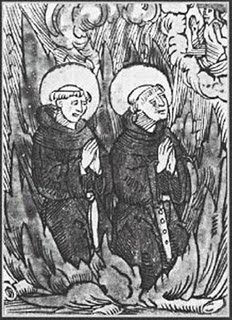
On July 1, 1523, two young Augustinian monks- Heinrich Voes and Johann von Esch (Hendrik Vos and Johann van den Esschen in Flemish)- were burned at the stake at Brussels, Belgium. Voes and von Esch were the very first martyrs of the Reformation. They died chanting the Te Deum.

The charges against Voes and Esch were that they taught the following:

1.That no on should be deterred from reading the works of Martin Luther;

2. That worldly authorities had no power over conscience;

3. That all Christians are priests;

4. That Christ is not sacrificed again during Mass;

5. That Scripture must be the foundation doctrine and practice (sola scriptura);

6. That Baptism, Communion and Confession are the only sacraments instituted by Christ;

7. That Jesus Christ Himself works good deeds through men; that men do not contribute except for allowing Christ to use them (a wonderful capsule statement of the Lutheran understanding of sanctification!);

8. That Christ did not appoint successors to Peter as Pope, or Bishop over all churches; and

9. That if the sinner believes he has been absolved, his sins have been forgiven.


Luther's response to the martyrdom of Esch and Vohs was to write his very first hymn, Ein neues Lied wir heben an (also known as Now Shall a New Song Be Begun, and With Help of God I Fain Would Tell), which appears in The Lutheran Hymnal as Flung To the Heedless Winds (tune here). The original, as translated by F. Samuel Janzow and arranged by Carl Schalk, is below.


Sadly, material relating to the martyrdom of von Esch and Voes, including an article entitled "They Seem Like Roses to Me," seems to have been removed from the website of Concordia Seminary in Fort Wayne.

Precious to the Lord are the deaths of His saints.

HT: Scleitheim.com, ConradAskalnd.com